


McLaren’s MCL36 Analysed – How real is it?
McLaren unveiled its all-new 2022 Formula 1 car, the MCL36, alongside its IndyCar, Extreme E and ‘Shadow’ Esports challengers in a typical McLaren-style launch show at the MTC.
Since Haas revealed what turned out to be a ‘version’ of its VF-22 in a series of online renders which was originally coined as a livery launch, and Red Bull subsequently revealed its livery on a Formula 1 show car, Aston Martin was the first team to show-off a ‘real’ 2022 car with the Silverstone-based outfit seemingly not gripping on to secrecy.
McLaren’s car is indeed its 2022 design – choosing to launch in a guise similar to counterparts Aston Martin. However, the team quickly revealed that certain components and entire areas of the car have been deliberately obscured from our view.
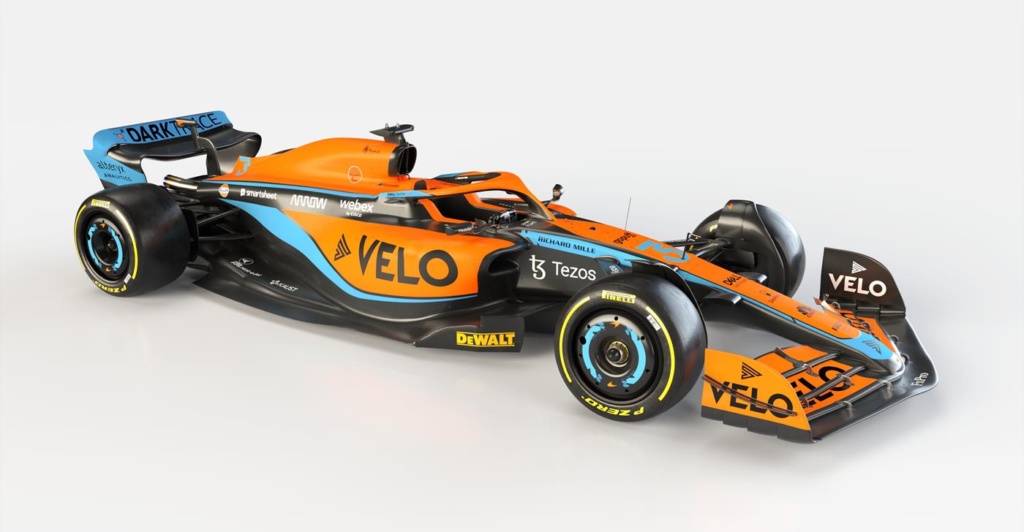
Image: McLaren Racing
The extreme nature of the changes to the technical regulations for this season means maximum secrecy is something each outfit will try to hold on to for as long as they can. Naturally, nobody wants to give away any thought-processes or intriguing trickery which could be adopted by rivals and effectively used against them.
The state of that particular zone of the car in the prescriptive regulations would ultimately decide how feasible, or how long it would take, for rivals to copy something.
There is clearly a physical cover placed on the entirety of the rear floor portion of the MCL36, and a neutral version on show in the renderings for the media.
Parts of the car that can be analysed however include the Aston Martin-style slim nose, with these two teams clearly sticking somewhat with what they know from the last couple of seasons of ultra-slim noses forward of the bulkhead and suspension.
The front wing itself is fairly low, perhaps lower than the AMR22 – but the MCL36 is yet to be seen on track to confirm this – and the elements set back and more curved in shape in comparison to the more serrated and angular nature of the Aston Martin wing. Maybe expect further additions to this area.
The suspension is a pull rod, but the suspension philosophy will only really be known for certain when the car hits the circuit.
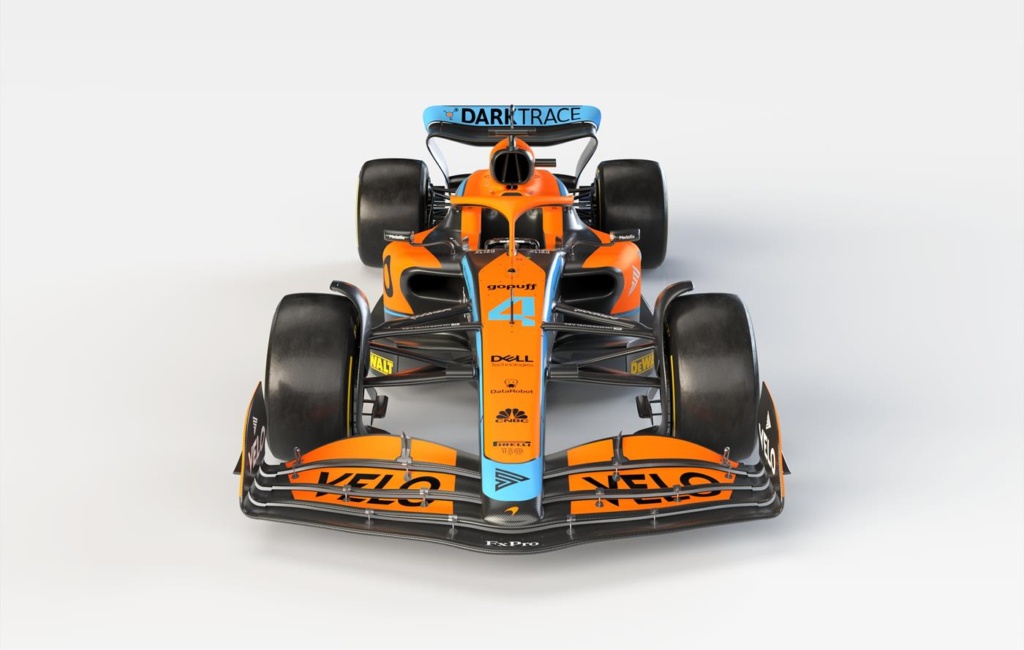
Image: McLaren Racing
In contrast to the Aston Martin, McLaren’s sidepod inlets are more oblong in shape and curved at their ends.
This is quite a conventional shape if compared to the season’s since the team adopted the revolutionary high sidepod design introduced on the 2017 Ferrari.
The horizontal dark grey bar-shaped section in the brand new and McLaren Racing-integrated livery, between the halo and the exhaust exit, creates a mild optical illusion, but one which fails to hide the interestingly shaped cannon-like shape to the bodywork around the exhaust and where the single rear wing pylon is seated.
An overhead view of the car, at least in the digital renders, palpably displays how different a philosophy McLaren is utilising in the sidepod area of the car, compared to Haas and Aston Martin.
The ultra-slim sidepods are the complete antithesis of the former’s design, which to a certain degree on the Haas is down to the layout of the Ferrari power unit.
Nevertheless, the clear differentiation between the coke-bottle-less shape of the AMR22, juxtaposed with this more conventionally-formed area on the McLaren highlights the flexibility that the Mercedes power unit (of which both teams run) offers.
It would be wise therefore to analogise that the McLaren launched on Friday is a ‘hybrid’ of a launch car, as McLaren’s Technical Director James Key explains that it is the car that’ll be seen in testing, but with delicate areas concealed.
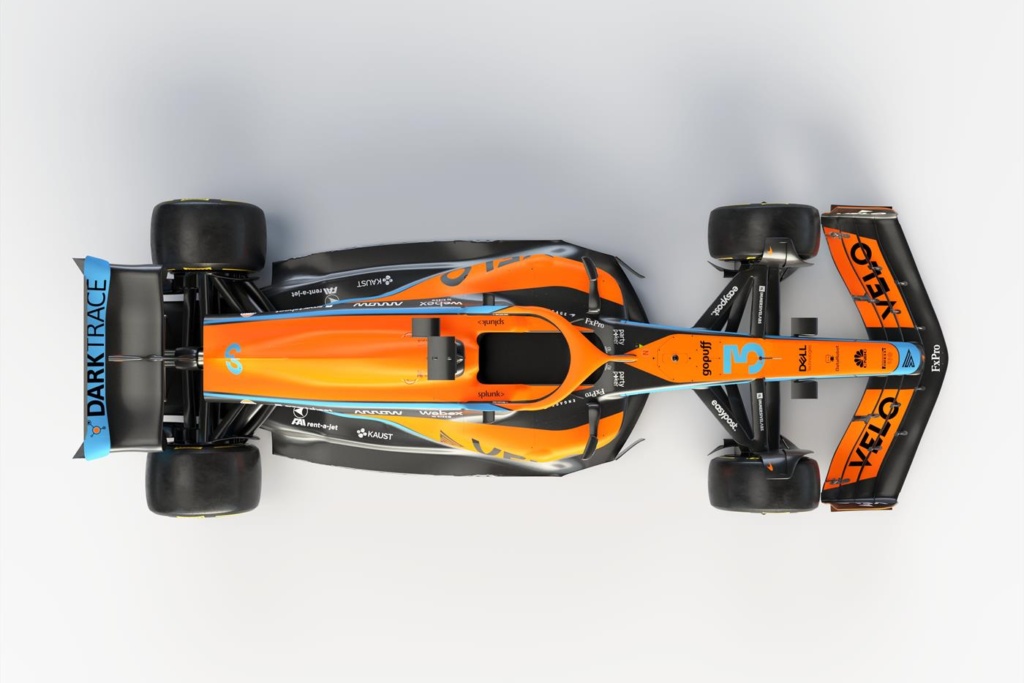
Image: McLaren Racing
“I think we can be proud of presenting our real car because it absolutely is. It’s the car we’ll be taking to Barcelona. Yes, we’ve hidden a few bits and pieces, for obvious reasons. There are some sensitive areas, but they’ll be seen when we’re running the car.”
“As far as the development plan is concerned, like every team, I’m sure we have development steps to come early on, because we’re still very much in the process at this stage where the development rate is pretty strong.”
“So, we’ll be bringing some updates to Bahrain. The next parts are already in the process now. You’ll see the car change but I’m sure everybody’s car is going to change.”
 Author: Danny Herbert

More from Danny Herbert
The Behind The Scenes Disagreement Between F1 Bosses In Canada
Formula 1 teams are entangled in yet another technical controversy which unsurprisingly reared its head on the Canadian Grand Prix …
Will F1’s Elder Statesmen Stick Around?
Age and experience brings wisdom and intuition, yet in Formula 1 it’s the young blood which is taking over the …
Why Are F1 Teams Removing Paint From Their Cars?
Formula 1 teams are facing all-new technical challenges this season, with innovative solutions required to gain a competitive advantage over …


